Showing posts with label organisation. Show all posts

Wednesday, 28 January 2026

How to choose a decluttering challenge that will work for you

I love decluttering, and I also love researching tips and tricks to help me keep my home decluttered and organised. I'm really motivated by a good declutter challenge.

Everyone is different, and something that works well for someone might not work for another person. I've gathered together some of the most popular decluttering challenges that you might find online, and thought about the advantages and disadvantages of each.

The 30-day Minimalism Game

Created by The Minimalists, the 30-day Minimalism game is my favourite decluttering challenge, and I've attempted it several times. Every day you declutter a certain number of items, based on the day of the month. One item the first day, two the next, and son on all the way to 30 or 31. Easy to start with, but by the time you get to the middle of the month it's definitely becoming a challenge!

Advantages - It's perfect for people that like to make lists and want a clear structure. At least in the early stages it doesn't take up too much time, and by the end you'll be able to see clear results. 

Disadvantages - If you miss a day it can be hard to get back on track, and it get overwhelming as you approach the end of the month (one way to avoid this is to do it in reverse). It requires a daily commitment. 

You can see how I got on with this challenge here - Playing the #minsgame 

Project 333

Project 333 was developed by Courtney Carver and it's a way of reducing clutter and stress by limiting the number of clothing items in your wardrobe. All you need to do is choose 33 items for 3 months, including clothing, accessories, jewellery, outerwear and shoes. Some categories are excluded, for example sleepwear, underwear and gym clothes (as long as you are actually wearing them to work out!)

Advantages - There is a great community around this challenge, so it's perfect for people that like to share their progress on social media. If you feel overwhelmed by deciding what to wear everyday then it removes that layer of stress from your life, and it's a great way to experiment with making the most of the things that you already own. Although it's focussed on clothing, it can help you to think about other areas of your life where you could simplify - for example in the kitchen or hobby supplies.

Disadvantages - It doesn't suit people that enjoy creating their daily outfits, or who use their clothing as a form of self expression. It's also a little tricky if you live somewhere with a changing climate or if your social or work life requires you to switch between different types of outfit.

A list of decluttering challenges
Photo credit Sarah Brown via Unsplash

One in one out

This challenge is just what it sounds like - every time you bring something new into the house you must choose something to leave, ideally in the same category.

Advantages - It works well if you have already done a big declutter and you are looking to maintain your space. It also helps you to think about what you are buying if you know that you will need to choose something to replace. It works well for families that have a constant flow of things coming into the house.

Disadvantages - It's not really a method of decluttering, more about stopping things getting worse. There won't be any impact on the total number of items that you own.

Declutter X items per day

This challenge works really well for me and I've done it several times. I go with 5 items every day for a month.

Advantages - It's a slow method, but enough to make a big difference. If you miss a day it's easy to catch up the next day and it's simple to keep track of. It doesn't require any major disruption to your home.

Disadvantages - You might become discouraged if you miss a day or two. It can also mean that you declutter more obvious things without tackling hidden areas.

The Marie Kondo method

Based on the bestselling book The Life Changing Method of Tidying Up, the key behind this method is to sort by category, and the categories are worked through in a particular order which helps you to practice making decisions about your items. 

Advantages - If you follow the method correctly then you shouldn't need to declutter again. There is a logical order to follow and it makes a lot of sense. For example, if you gather together a certain item like pens in one place you can really see when you have too many.

Disadvantages - It takes time, and depending on the level of clutter in your home it can be disruptive. Ideally you need to have space for a staging area where you can gather your categories of items together, and it can be overwhelming to see everything laid out together at once. 

Here you can read about how I used the Marie Kondo method to declutter an older child or teenager's room

The area by area challenge

This challenge is almost opposite to the Marie Kondo method. Instead of grouping by category, instead you concentrate on one area, for example a drawer or cupboard, at a time. There are many different lists that you can follow to give you some areas to work on within a certain time frame, for example this 30 day declutter challenge.

Advantages - Because you are only working in a small area each time, mess is kept to a minimum. It works well if you can dedicate a small amount of time each day to decluttering, and you can choose your area based on how much time you have that day.

Disadvantages - It doesn't give you a full overview of your clutter - you might still end up with a spare pair of scissors in every drawer. You might feel the pressure of having to work on the particular area in the challenge list.

The packing party or box method

This is another decluttering method championed by The Minimalists. It's a great way to get a fast result, you just pack up everything that you own into boxes and then you spend a month or so only unpacking things as you need them. In theory you can then get rid of everything else!

Advantages - It's an extreme method, so it's perfect for people that want to have a huge clear out. It's particularly suitable for people going through some kind of home transition, maybe moving house or doing renovations. 

Disadvantages - This doesn't work well well for everyone, for example if you have a large family, as it's very disruptive. You need a lot of time and energy to pack everything up, as well as a large supply of boxes and bags. Because the challenge takes place over a short period of time, it doesn't account for seasonal items or special occasion clothing.

Piles of cardboard boxes ready for moving house
Photo credit Brett Jordan via Unsplash

My thoughts

I personally find a decluttering challenge a powerful way of motivating myself to make some space in my home. Throughout January I've been removing 5 items per day, and I'm definitely noticing and appreciating the results. 

All of these challenges can be adapted to make them easier or more realistic for you, and because they are all popular challenges there is plenty of advice and guidance online from people that have found what works for them. 

Good luck if you are attempting a decluttering challenge this year!

Friday, 28 November 2025

What I look for when choosing a planner - and which one I ended up buying!

As the end of the year approaches it's time for me to start thinking about buying a planner for next year. I use my planner throughout the day to keep track of the things that I need to get done over a week - housework, keeping track of everyone's activities, planning my exercise, meal planning and so on. I use an online shared calendar for future dates, so I usually only plan week to week, with monthly goals in mind.

My current planner was bought in the US so there's no way that I can buy the same one again. I decided to make a list of the features that I would like before I searched around to see what was available.

Features that I need in a new planner for 2026
Photo credit 2H Media via Unsplash

A whole year calendar page at the beginning - This is so useful to see birthdays and other important dates at a glance, as well as marking out school and family holidays.

Week to view pages - with plenty of space for writing out my daily tasks and goals.

Dated - I like to have the dates written out for me as I'm going to be using it every week.

Monthly dividers - I have found these really useful in my current planner.

Monthly page - This is a really great place to keep track of goals and tasks for the month. I have a monthly list of regular cleaning jobs, boring things like deep cleaning the dishwasher and descaling shower heads, and they all get listed here to complete at some point over the month.

Weekly task list - This is something that is missing from my current planner and something that I would really like. Sometimes there is something that needs to be done at some point during the week but I need to wait and see when I can fit it in.

Blank pages at the front and back - For extra notes like log in details (written in code!), gift ideas, long term projects.

Plenty of space for writing - I need nice large boxes for every day to fit in everything that I want to get done. 

Spiral bound - So that it can lay flat for easy writing. Also a pretty cover is nice to have, although I'm always happy to customise if I'm not 100% keen on it.

A5 size - The perfect size for me to keep out and take with me if I need to.

Not too expensive - Even though it is something that I use every day, I don't want to spend too much.

And some of the things that I don't need...

Inspirational quotes - I love a good quote, but sometimes they are so cheesy!

Daily timings - I need to keep things flexible, I can't commit to planning my day in hourly detail.

Drinking water trackers - These are very popular! But I'm pretty good at staying hydrated, and I can't see myself bothering to tick off each time I have a drink.

Individual tick boxes - Usually there aren't enough for all the things that I have to do!

Obviously it's going to be difficult to find the perfect planner, but I'm pretty happy with the one that I've chosen. After much consideration, this is the planner that I went with - 2026 Planner week to view (affiliate link).

New planner for 2026 - what are the features that I need

I'll admit that it was the beautiful cover that jumped out at me, but after searching through pictures from the inside I was happy that it covers everything that I need. The monthly planning page is a bit hidden at the end of the month and the boxes don't have many lines for writing, but there is plenty of blank space for customising with stickers, loads of spare pages for notes at the front and back, and a handy pocket for storing any loose items.

Weekly page from my new planner for 2026

Do you use a planner? I'd love to know what features you think are the most important when choosing one for the next year!

Wednesday, 17 September 2025

How I've decluttered my home over the past year

I've carried out several decluttering challenges over the last few years, like the #minsgame and decluttering 100 items in a week. I do try to keep on top of organising and decluttering my home, but recently I've really noticed that the unwanted things were starting to pile up.

With the building of our extension and having new carpets fitted we had to empty most of our rooms, and it really makes you realise how much clutter you have lying around when you have to pack everything up and store it somewhere that's in your way. Our garage was also in a mess as the workers had been sawing wood and storing rubbish there, and we had huge piles of cardboard everywhere.

Another thing I realised is that there were lots of items lying around the house that I didn't want anymore, but just didn't know what to do with. Every time I saw these things it reminded me that I needed to do something about it, and now that I've passed on many of those tricky items I feel so much calmer when I look around the house.

So I've had a really good clear out! Here are some of the ways that I moved things along:

Friends and family

This is always the first port of call, just on the off chance that someone needs something we are getting rid of. I have a friend who is a primary school teacher and so I pass on lots of toys and books which she can use in her school.

eBay

I had great success with selling things on eBay, in particular Lego. It was a lot of work - I had to build sets, find missing pieces, photograph, research key selling points and prices, and then keep an eye on the listings and make sure I was posting things out on time. But now that it's done and I've made several hundred pounds I can't believe we were just sitting on all that money!

Pile of boxes ready for selling on eBay

CEX

Another way we've found to successfully sell items is with CEX. You can use their drop and go service to create a basket of the items that you want to sell, choosing the item and condition from the lists on their website. Then you just take it into the store to drop it off, they do a quick check and then call you within an hour or two to confirm the price they will offer. We filled several shopping bags with old electrical items, some which had been sitting around for years, and they took almost everything. We made a decent amount, and even the things which weren't worth a great deal will at least be recycled if they can't sell them. They will also offer more money if you choose a store voucher rather than the cash.

Facebook free sites

We have an active 'Free before the tip' Facebook group which I've made a great deal of use of. It's brilliant for larger items like furniture and random things which you know could be useful to someone. I have been messed around a few times - it's funny how you can post something and someone will jump on it immediately in the comments. but when you try to arrange pick up they go silent for days! But overall I've had a good experience, and it's a great feeling to pass on something useful that someone wants.

Charity shops

We have a new charity shop and donation centre which has opened in an old petrol station on my school run. It's perfect - plenty of parking and they are always grateful for donations. I can never resist having a quick browse myself though, I'm always on the lookout for books and jigsaws!

Inside a charity shop
Photo credit Julien-Pier Belanger via Unsplash

Textile recycling

There are plenty of textile recycling bins in the area which are easy to get to, and I also use the charity bags which we get through the door. I sometimes use these for the clothing and household linens that aren't in good enough condition to donate to a charity shop.

Local metal collector

There's a local man who is always happy to come and collect scrap metal for free. I usually wait until I've got a pile together and then message him on Facebook, he comes straight away.

Local licensed waste collector

We had to say goodbye to Mia's loft bed over the summer as she had outgrown it and it took up so much space. There was no way we could remove it ourselves - it took us a whole day to assemble and the larger pieces wouldn't fit in our car for the tip. I found a local company that disassembled and removed it for a very reasonable price.

Council recycling and waste

We managed to get away with only one trip to the tip over the summer for those larger items of rubbish that wouldn't fit in the bin. Otherwise I sent a lot of rubbish out with our council recycling collection and waste collection. We are very lucky at the moment because they will take extra rubbish, next year we are switching to fortnightly collections and a smaller bin so it won't be as easy.

Plants and flowers on a wooden sideboard

Now when I look around my home I love seeing all the empty space. I've cleared many corners where things were piled up, and it makes me feel so much calmer. Of course there is still plenty to do, because decluttering is a job that is never finished. But I've had such a good go at getting it under control, and I know that now I can keep on top of it all. 

Monday, 30 October 2023

An update on my Bullet Journal

I started my first Bullet Journal nearly a year ago, and it's an organisational system that is working really well for me! I wrote in January about how I was trying out a Bullet Journal, and as I've just migrated to my second journal I thought I'd write a little update with how I'm getting on, and what has changed since I started using it. 

My first Bullet Journal was an A5 Seawhite Journal from Hobbycraft and I paid £8.50. This is a really thick journal with lovely sketchbook thickness pages. Unfortunately it was rather wasted on me as I was only using it for writing, and I found the ink didn't flow very well. It's much more suitable for people that want to get a little arty with their journals as it holds watercolour paint very well.

For my second journal I bought an A5 Bullet Planner in store from Flying Tiger which cost £5. It's very slightly smaller but the pages are much thinner and smoother to write on. It also has a pen holder which the Seawhite one doesn't have, and two place marking ribbons. I much prefer it! 

One of my simple Bullet Journal pages

What worked and was carried over

My daily/weekly/monthly planning system - this still works really well. I make it a habit on a Sunday afternoon to transfer tasks from the nearly completed week to the next, and to make my weekly page for the following week and a monthly page if needed. 

My yearly calendar of regular dates - I've really kept on top of birthdays this year by making it a habit to check important dates that are coming up.

My list of passwords and registration details - These are written down in a coded format in case I lose the journal. I've referred back to it many times!

The Household Tasks planner - This is a list of regular household tasks with a highlighted checkbox to show how often they need to be done, things like cleaning out the lint in the tumble dryer, a maintenance wash of the dishwasher, defrosting the freezer. This has been so helpful, and I've really kept on top of these boring jobs that get worse if you don't do them regularly.

The To Watch page - I like to keep a list of things which I want to watch or which have been recommended to me. I trimmed it a little for the new journal, as it was a good time to see what was still relevant.

What didn't work and has been left behind

The Exercise Tracker - I very quickly lost interest in this! I just didn't find it useful, I can tell by how I'm feeling whether I've exercised recently or whether I need to go out and do something.

Monthly habit trackers - I still use these occasionally but not as often as I was intending to.

My To Be Read pile - This was useful when I started the journal as I had a whole page of books that I needed to read. Now that I've caught up with it (following these tips - How to conquer the To Be Read Pile!) I only have 5-10 books at a time which is more manageable. I read so quickly that I don't want to keep going back and adding/removing books, and I track my reading in Goodreads. 

Too many lists of projects - I had lists of craft projects, home projects, long-term projects, goals for the year and so on. It was too many pages to keep track of, so I'm going to pick out the key ones and make just the one page in the new journal called 'Projects'.

Contact details - I never ended up filling this page in, I have all the information I need stored elsewhere.

Woman writing in a journal
Photo credit Kelly Sikkema via Unsplash

I'm really pleased with how well I've kept up with the Bullet Journal system and I've found a way to make it work for me. I was a little over enthusiastic at first when I was seeing all the inspiration online and wanting to make pages for everything, but over time I've managed to pare it back to what I really need!

Do you keep a Bullet Journal? If you want to know more about the system this is a good place to start - The Bullet Journal Method. I'd love to hear how you use one!

You might also like this post - Things that don't go in my Bullet Journal

Friday, 8 September 2023

Organising my Hama beads

I haven't posted any Hama bead crafts for a while have I? That's not because I haven't wanted to craft with my Hama beads, but because I was getting a bit overwhelmed. My love for Hama beads hasn't gone unnoticed among friends and family, and as their children outgrew the beads I became the happy recipient of many large boxes of unsorted beads! In addition to my own supplies, I found that I had a cupboard full, and I couldn't even think about where to start.

Over the summer my niece visited for the day and she enjoyed using some beads which I pulled out for her. So I decided to start by sorting out a box of basic colours for her along with some boards so that she could do some Hama bead crafting at home. I had five massive boxes of unsorted beads, and so this prompted me to finally get down to it and work on sorting out the beads into their individual colours. 

This was a huge job, and it took me several weeks. Unfortunately I forgot to take a photo of what I began with! I tipped out handfuls onto a large tray and patiently picked through the beads, sorting them out into a variety of plastic cups, beakers and empty food packaging. Anyone around at the time was encouraged to help me out!

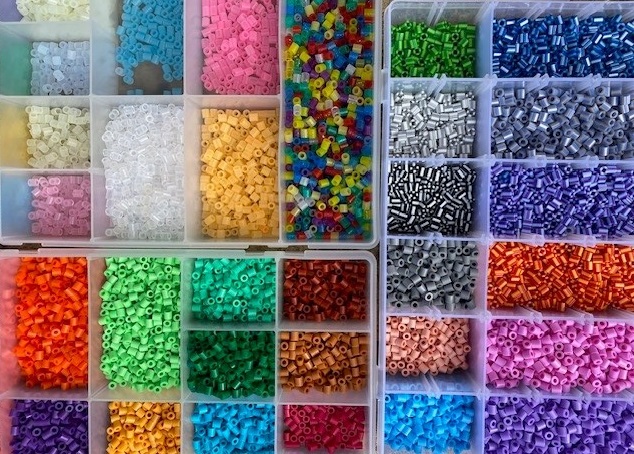
Hama beads sorted by colour in storage containers

I didn't really find any easy way to sort the beads apart from trying to do it during daylight to more easily see subtle colour variations, and making sure I had enough containers for all the different colours. It was actually very relaxing!

I already had some of my Hama beads sorted into plastic storage boxes but the colour selections were haphazard and most sections were too small to fit all the beads I wanted. I also had way more colours than sections. So I emptied out the different boxes and also purchased a new box for the extras. It wasn't enough to hold all my beads but I didn't want to spend too much money so I used sturdy sandwich bags for the more popular colours and tiny plastic bags when I only had a few beads of a particular colour.

It's really satisfying now to see all my beads clearly laid out. I know what colours I have and how many of each colour, so I can plan my craft projects. In particular I have plenty of transparent beads, neon beads, skin tones and red and white beads, so expect to see those cropping up in future blog posts!

Having such a big sort out has really re-ignited by love for this craft, and I'm really looking forward to crafting with Hama beads again!

And if you want to see my Hama bead storage goals have a look at this - Ultimate Hama bead storage - I'd love to splash out on some of these tiny boxes for my Hama beads, I'd just need so many of them!

Friday, 24 March 2023

Organising my life in a more analogue way

Since I started my bullet journal at the end of last year I've been really enjoying a more analogue approach to planning. I have shared a few things that don't go in my bullet journal, but the majority of my planning can be found in there and it has now replaced the digital planning system on Trello which I used for a long time.

I find that when I write things down with a pen and paper they are far more likely to stick in my brain. It's also much more satisfying to scribble out a completed task that to simply drag and drop it to the next day! Not to mention that it helps to keep me away from my phone screen. Like many people I am quite capable of picking up my phone to quickly check something and then find myself emerging in a daze after half an hour of aimless scrolling.

I've also started keeping a small notebook in my handbag which I can use to make notes while I'm out and about, mainly while I'm parked up at school waiting for the children. I have a few ongoing lists there that I add to, for example books that I want to read or buy and songs that I want to add to my running playlist. 

Person writing things down in a notebook
Photo credit Kenny Eliason via Unsplash

Since I started my bullet journal I've noticed a real shift in my approach to regular tasks which I can only explain by the fact that when I have everything physically written down it makes me more likely to get things done. For example last week I had scheduled to defrost the freezer, a job which I normally do every few years and I hate it because it takes hours. But because I last did it only a few months ago it took half an hour and was so easy! It was a real lesson in keeping on top of things rather than letting them get out of control, and my bullet journal is making it really easy for me to track those types of tasks.

I've also enjoyed using my planner to schedule in things that aren't tasks as such but things that I want to do. For example to do exercise, watch a television programme that I'm interested in or to spend time working on a particular craft project. This makes sure that I actually get on and do it because I've committed to it by writing it down, rather than having it float around as a vague idea.

I'm really enjoying using a pen and paper regularly again after going a long time hardly writing anything at all. I'm feeling pretty much on top of things at the moment and enjoying making plans and putting them into action!

Friday, 17 March 2023

Sorting out our masses of Lego and Playmobil

We are lucky enough to have a guest bedroom on the top floor of our house, a big room with a double bed and plenty of floor space. But during covid and those long months at home I allowed the children to use the guest bedroom as a playroom and a home for their many and varied large Lego and Playmobil sets. The children don't play up there anymore, and we don't heat the top floor over the winter, so I had forgotten just how messy it was. Faced with the imminent prospect of house guests I ventured up to see what I could do to tidy it, and I was quite overwhelmed when I realised the scale of the job in hand.

They had several large Playmobil sets with pieces scattered across the room, and most of the pieces from multiple sets all jumbled together in a large miscellaneous box. Then there were Lego sets, some set up, some half dismantled, all covered in dust and all mixed up. I'm usually quite organised when it comes to the toys and I found it really stressful to see them all in such confusion! So I decided it was time to have a good sort out.

We decided that we wanted to keep the larger Playmobil sets and all of the Lego, which is fine and I'm happy for it to be kept, but I wanted it all in order. I had kept all the instructions and inventories for each set, so I hauled them all out and began on a mammoth sorting task beginning with the Playmobil.

It was quite a job, and it took me many hours spent up in the cold room. I went through all the pieces and worked out which set they went with. I managed to find the vast majority and assign them to a set, there are a few small bits missing but there are more than enough pieces to make up playable sets. The smaller sets were bagged up and lent to my parents for my niece to play with when she visits.

Large blue plastic tub full of Lego bricks

The Lego was more difficult. While looking for a picture for this blog post I came across this ancient post - How I organised the Lego - and I had to laugh at how much simpler our Lego set up was way back then! The children chose their favourite sets and took them away for display in their rooms. Then I broke up the smaller sets and put them away in boxes, as well as sorting through the huge tub of miscellaneous Lego bricks to find any missing parts.

Again, I couldn't find everything, but I think I did a decent job. Now that it is mostly packed away I have officially handed it over to the children. I've said we will store it for them as they are good quality toys that they want to keep, but as soon as they own their own homes with a loft they become their responsibility, and if they want to make some pennies by selling it all on eBay sooner then they are welcome to!

It's amazing what a difference sorting it all out has made to me. Even though I wasn't seeing the room daily, it was always there as a future job at the back of my mind and now it's done! It was a little bit emotional for me because I have loved watching them play with these toys over the years and now they are all grown up. It's not perfect as we still have lots of boxes of toys. But I do keep going up there to admire all the extra space that we now have, and how clean and dust free it all is!

Friday, 3 February 2023

Things that don't go in my bullet journal

Recently I wrote about how I've been trying out the bullet journal organisation system. I've been using my bullet journal for about two months now and I'm loving how well it's working! The system makes a lot of sense to me when it comes to planning both in the short term and long term, and it's helping me to keep up with both my daily tasks and my long term goals.

I appreciate how customisable the bullet journal system is, and I really enjoy both reading about and taking inspiration from ways in which other people use their bullet journals. But as much as I'm enjoying using this analogue system, there are some things that just don't work for me in the bullet journal format. 

Woman writing in blank journal
Photo credit Kelly Sikkema via Unsplash

Long term calendar or Future Log

For years we've been using an Outlook calendar, because that's what we use for our personal e-mail. It works very well because I can sync with my husband's calendar and we will probably also add the children as they get older and more responsible for their own diaries. In my bullet journal I only work a week or two ahead, and because we have so many things in the calendar I would soon fill up a Future Log type page. So at the weekend I will go through our shared calendar and make sure that any appointments for the next week are added into my weekly pages, as well as adding them in as the week progresses.

Weekly shopping list

We use an app called Our Groceries which is brilliant for organising our weekly shopping list. Again it can be synced so that both me and my husband can use it, and it's sorted by category to make it easy to add to the online shop. If the list was in my bullet journal only I would see it, and it would be repetitive having to write out the same things each week. It also means I always have the list with me on my phone, as I don't usually take my bullet journal out with me.

Meal planner

I use the Notes app on my phone to keep a list of the meals that I want to make for the next few days, and I don't tend to allocate each meal to a day as I like to keep it flexible. I'm also using my phone to add things to the Our Groceries app and also to do the online shop. I do however have a long list of meals to choose from which is currently stored in Trello, but I may move that over to the bullet journal at some point.

Holiday packing list

I have a very comprehensive holiday packing list which is stored as a Word document on the PC. It covers all sorts of different holidays - self-catering, cruises, camping and so on - and when we are going away I print it out and cross through all the things that aren't needed on that occasion. I definitely wouldn't want to be writing everything that we need out on a separate page each time we go away!

Reading log

I do use my bullet journal to keep track of the books in my to be read pile. I find it very useful, and I enjoy highlighting through books as I read them and adding new ones to the bottom. But I don't use it to record my thoughts, star ratings or anything like that. Instead I use my Goodreads account to keep track of everything that I've read. This is mainly because I know that my bullet journal won't be around forever and I'll probably recycle it when it's full, so the Goodreads account lets me store that information for longer. 

Brainstorming

I have a rough notebook that I use for brainstorming - writing down ideas for craft projects and blog posts, general to do lists and so on. I'm finding that my bullet journal is filling up quickly enough just with weekly and monthly pages and so I don't want to waste all the pages with rough notes that are just going to be scribbled out! I might take out the best ideas and add them to my bullet journal if I think that I'll be referring back to them, for example a particular list of things that I want to work through.

What things do you find don't work for you in the bullet journal system?

Wednesday, 11 January 2023

Trying out a bullet journal

I have had my eye on bullet journals for a while. They are everywhere on my social media, gorgeous decorated journals embellished with coloured pens and washi tape, which claim to be invaluable if you are looking to organise your life. I've always been pretty happy with the organisation system which I developed using Trello but one disadvantage was that you need to be online to use it and I've been trying to reduce my smartphone use. 

I also really enjoy writing things down on actual paper, and I hanker back to the Filofax system that I used through college and university. Over the summer I was shopping with Mia and she picked up a new journal which had dotted pages. I explained to her that it was designed for using as a bullet journal, and I showed her some websites with inspiration. She loved it, and started using it to track all sorts of things, and I was so impressed that I decided to give it a go myself!

The original bullet journal system was developed by Ryder Carroll and you can read all about it on his website Bullet Journal, where you can also find a short video explaining how it all works. In the years since he shared it people have picked up his ideas and run with them and you can find all sorts of bullet journal inspiration online, including some really creative and complex layouts. 

It can all be a bit intimidating to start with, but I've been having a lot of fun coming up with a way to combine the creative elements with a practical organisational system, and it's working really well for me so far.

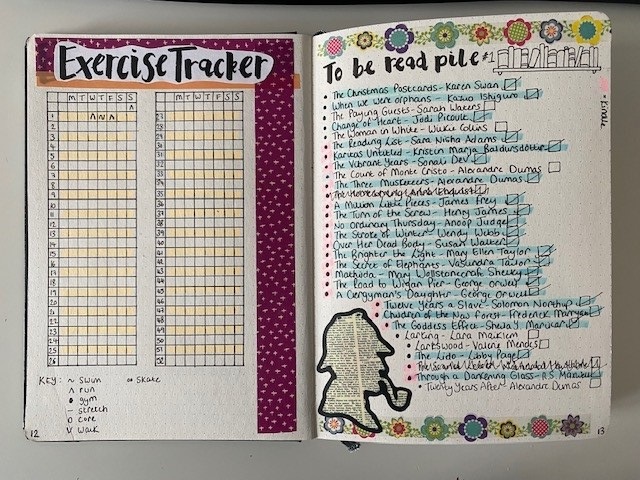
At the start of my journal I have my 'collection' pages. These include a list of books to read, craft projects to work on, things to watch, an exercise tracker. I also have some information pages - birthdays throughout the year and important registration details. My inside pages are my vision board with pictures of things that I enjoy and want to do more of - sketchbook pages, piles of books, people running, healthy food, that kind of thing.

Bullet journal collection pages exercise tracker and to be read list

Each month I make a monthly page. This includes a small monthly calendar, a weight tracker, a website stats tracker, habit trackers and two lists called 'monthly jobs' and 'personal tasks'. These two lists are where my bullet journal is really helping me.

I created a page called 'Regular Jobs' where I made a list of all the things that need doing around the house on a regular basis. Things like a maintenance clean of the washing machine or dishwasher, scrubbing grouting, hoovering the car, changing various filters. Then I decided how often to do those jobs and marked them against the month. Each month I can refer to this list and write out the jobs that I need to do that month. It's really helpful!

The 'Personal Tasks' list is for things I want to achieve, and relates back to my goals for the year. So this month I wanted to come up with some new running routes, plan some craft stash projects and plan my February blog content.

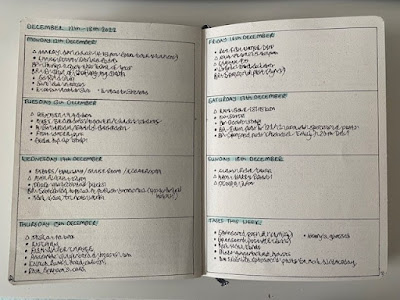
Then I make a double page spread for each week. First I fill in my regular daily household jobs. Then I put in any fixed dates or appointments and add some of my monthly tasks to make sure that they get done. When I've completed a task I take great pleasure in scribbling it out. It's not very pretty but it definitely gets the job done!

Bullet journal weekly spread completed

I've been using my bullet journal for nearly two months and it has been so helpful! The main thing that I've noticed is that my house is looking a lot cleaner now that I am keeping up with the housework. I've made great strides with my reading pile having seen it all written down, and I'm definitely feeling much more organised. The system might not work for everyone, but it's definitely something that works really well for me!

My bullet journal supplies:

I bought my bullet journal from Hobbycraft - it's a Seawhite Dotted Bullet Journal and it cost £8.50. It seemed expensive at the time, although I had a voucher to put towards it. I'm very pleased with it, and there are plenty of nice, thick pages. It has a ribbon bookmark and a folder at the back but it doesn't have a pen loop which is a bit inconvenient. I have just ordered some stick in pen loops, so I'm hoping they will work well.

For writing I am currently using a Stabilo Fineliner pen and I also use a brush pen to make pretty titles. The pen is comfortable to write with but I have found that on a couple of pages it has smudged when I must have spilled a drop of water. Annoying because it makes it look messy! I might switch to a biro when I've run out these pens.

For decoration I've been using Zebra Mildliner pens which my daughter introduced me to. She loves them! They are double ended and they come in lovely colours. We bought a huge pack of 30 at Costco so we have enough to keep us going for a while! I've also been using some of my huge supply of washi tape and stickers.

Friday, 2 September 2022

Different types of decluttering challenges

I always find myself in September with a longing to sort out the house once the children are back at school. I find that a good decluttering challenge helps me to stay motivated and can make a big difference to the tidiness of my home, so I thought I'd share some of my favourite challenges below. Some of them I have tried in the past with great success, and others are ones that I definitely want to attempt in the future!

The Minimalism Game

I love playing the Minimalism Game, and I've done it several times over the years. It's very simple, you just discard the same number of items as the number of the day in the month. So Day 1 is one item, Day 2 is two and so on. It's very easy to start with, but it's pretty tough by the end! It also requires a certain amount of self-policing - for example do you count smaller items in a container as a group, or as individual items? A twist on the game is to play it in reverse, so that you get the most difficult part out of the way first thing. 

A certain number of items each day

This is the challenge that I'm working on this September. It's a variation on the Minimalism Game, but you remove the same number of things each day. For me, ten items per day is a manageable amount.

A particular amount of time each day

Set a timer, for example fifteen minutes or half an hour, and declutter as much as you can during this time. This challenge doesn't work so well for me because I get easily distracted and then panic that I'm not working efficiently, but I can see this being effective if you have a very cluttered house or lots of rubbish lying around.

A different area each day

Plan for this by making a list of all the areas in your house that need decluttering but try to keep it manageable, for example a cupboard or drawer at a time. Then work on one area each day. It's best not to be too rigid about it, and to keep the larger or more difficult spaces for days when you have more time.

Surface cluttered with red objects
Photo credit Elena Mozhvilo via Unsplash

A different category each day

This is the core of the Marie Kondo method and I find it works really well for me when I need to have a big clear out. Sorting by category means that it's easy to get rid of duplicates which might be missed if you are working on different areas at a time. It can be quite overwhelming and messy at times though, and you need to have the space to set aside an area for sorting.

Declutter the things that you don't use

This challenge works really well for clothing but can also be used for other items. Take out all your clothes, and only return them to the wardrobe or drawers once you have worn them. After a certain amount of time you will easily be able to see the clothes that you don't wear regularly and pass them on. Of course there are exceptions for seasonal items and special occasions, but it's a good way to remind yourself just how much you own.

Sorting through piles of clothes to declutter
Photo credit Sarah Brown via Unsplash

One item in, one item out

Every time something new enters your home, something else must leave. Ideally this would be something from the same category, for example a new pair of shoes or a book.

Join in with an online guided challenge

There are plenty of online challenges that you can take part in which can be very motivating and inspiring if you want to share your progress with others. Often there is an attractive printable calendar available for download.

My favourite challenges are run by Apartment Therapy, and they host regular free decluttering challenges using a daily e-mail to keep you on track. The next one starts on the 19th September 2022 and you can sign up here - Decluttering Cure 2022. You can also find the older completed challenges with links to the daily tasks, for example the January Cure which I did this year, or a previous two week Decluttering Cure challenge.

I hope that I've given you some inspiration for a September declutter!

Tuesday, 16 August 2022

Using the Marie Kondo method to declutter an older child or teenager's room

For a little while my teenage son's bedroom had been descending into chaos, so I decided that we would tackle it together at the beginning of the summer holidays and have a really good clear out and clean. I'm a big fan of the Marie Kondo method for decluttering and organising, and so I decided that we would use this method in his bedroom. It was really successful and his room looks so much better now,  so I thought I'd share how we used the method on his room.

The Marie Kondo method involves sorting possessions by category. You start with categories of items that have little sentimental attachment and can obviously be removed. The main categories are clothes, books and paperwork, and then you move onto the smaller categories which can be customised based on the sorts of things that you own. 

I came up with a category list before we started, and I also added things as we went along. I've shared our category list below, and I'll go into detail about each one.

Marie Kondo for a child or teenager's bedroom

Downloadable a printable version of the checklist

Before you start, if possible clear a sorting area and gather together large boxes, bin bags, and bags for charity donations. As you sort you will find things that belong to later categories or to a new category so it's a good idea to have somewhere to keep them. Prepare for a few days of mess!

We did the declutter slowly and worked on a category or two every day. I planned the next day's category in advance and where possible gathered the items together in my sorting area. That way we both knew what was coming up. If we had a busy day then I planned a smaller and easier category to work on. 

I also cleaned as we went along, for example pulling out the bed to hoover underneath and giving the window a good clean. As the room begins to empty it's a good opportunity to think about whether your existing storage systems are working, and whether you need to look at repurposing or purchasing new storage.

Clothes - For me this is the easiest category for children as it's really obvious which things have been grown out of and can be passed on. I also keep on top of it anyway - every time we pack for a holiday I take out the things that no longer fit! I take clothes that are still in really good condition to the charity shop, and those which are a little more worn to the supermarket recycling bins.

Books - Again I find this quite an easy category as children's interests change so quickly and they grow out of books. But I am also quite careful here as I've recently found myself re-purchasing some of my old childhood favourites! So I found Harry a large box for carefully chosen 'sentimental' books which he can keep in his wardrobe.

Paperwork - I tried to start with the least sentimental items of paperwork, so for a child this includes instruction leaflets for toys, schoolwork, old notebooks, certificates and all the random pieces of paper that end up lying around. Some of the paperwork can be dealt with in the sentimental category, for example photos, letters and postcards, diaries and journals. 

Bags and accessories - Hats and caps, jewellery, belts, ties and so on.

Stationery - I like to sort this into 'current' stationery, including school pencil cases and desk stationery, and 'spare' stationery for when this runs out. Make sure that the pens all work, pencils are sharpened etc. and there isn't too much excess in the spare category. 

Decorative items - Pictures on the walls, cushions, blankets, fairy lights, ornaments and trinkets.

Jigsaws and games - Always a satisfying declutter as the boxes take up lots of room! I included card games, board games and puzzle games in this category.

Large toys - Playmobil sets, dolls houses, marble runs and so on.

Construction sets - For my son the majority of this category was Lego, also KNEX, Meccano, and magnet activity sets. 

Action figures and dolls - Also the accessories that go along with them like bottles and clothes.

Small toys and collectibles - Figurines like Pokemon toys, Shopkins, LOL Dolls and I also included trading cards. If you are getting rid of these then it might be worth looking at whether it's worth selling as they may have some value.

Completed craft projects - This was a surprisingly large category. Pottery painting efforts, sculptures from school and various other creations. Luckily much of it was no longer wanted!

Soft toys - Possibly the toughest category! But I found that putting stuffed animals together in one place really helped to see just how many there were. Our school loves to take these as donations for the soft toy raffle at the summer fair.

Sentimental - All those precious things that are much harder to part with, although my son was much more ruthless than I expected. I found that we had different ideas about the things that would be sentimental to him, so I had to let him take the lead! It could be photographs, ticket stubs, holiday souvenirs, postcards, gifts from friends or relatives, journals and so on. 

Extra categories - All children are different and you are bound to come up with extra categories as you go along. For example - toiletries and makeup, computer games and gaming accessories, DVDs, sporting equipment, badges, craft supplies.

Teenage girl's bedroom decluttering
Photo credit Kenny Eliason via Unsplash

For me the most difficult part of the tidy is getting rid of the excess items. There are lots of options - passing things to a younger relative or friend, selling, donating to a charity shop or recycling for example, and ideally it should be done as soon as possible. I like to at least get things neatly packed up so that I can grab a bag or two to take to the charity shop or deliver to a friend when I get the chance.

Just one last thought - when it comes to decluttering with children I think that the age of the child makes a huge difference. With very young children I think it's best not to really involve them, and instead I would just do the decluttering myself. Many of their possessions are ones that they've been given and they outgrow things so quickly. 

But older children have many more things which are sentimental to them, and things that they've specifically requested as gifts or chosen and purchased with their own money. So I think that using the Marie Kondo method works really well with older children and teenagers. I also think that regular decluttering is a really good habit to work on while they are younger so that they learn to keep on top of things, and hopefully they will remember this method so that they can use it in the future.

Category list background credit - Alessio Soggetti via Unsplash

Monday, 31 January 2022

Writing a blog post every day in January

At the end of December, like most people, I made a list of a few habits that I wanted to work on for the New Year. You can read more about them in my book review of Atomic Habits. One of the things that I wanted to do in January was to write a blog post every day. Not to publish, just to write one and schedule it to publish at a later date.

I really did find it a challenge as some of my posts can take quite a bit of time to put together, but I managed it! And it was so successful that I'm planning on continuing for February. I love being able to plan my content properly rather than scrambling to post something, anything, at the last minute. It also gives me the flexibility to add in any collaborative or review posts when I have plenty of my own content ready to keep things balanced.

Hands typing on laptop keyboard
Photo credit Mel Poole

I did spend a bit of time in advance getting myself organised. Before Christmas I had already planned my editorial calendar for January, and although I hadn't yet written any posts I had a clear idea of what I wanted to write about. I went through my lists of blog post ideas and I was able to come up with a complete list of 31 posts to write. Then I planned roughly which ones I would be writing each week, sorting out which ones would be straightforward and which would need more work in terms of crafting and photographs. 

Because Christmas was still fresh in my mind I wrote a few Christmas themed posts which are now scheduled for this December. I also made a start on some Easter content and there are some general posts which aren't time specific. I now have a great deal of my February content written and some posts scheduled for March. 

Despite all the planning I kept it flexible, so I was able to move things around and add in any posts that I felt like writing on the day - for example writing about Mia's adopted gibbon and Harry's birthday. I also made a start on some longer posts in advance with photos, notes and any affiliate links ready in a draft post that just needed to be written up and checked over on the day. 

I'm really pleased with everything that I got done this month. I feel very organised and able to concentrate on some of my other projects, which in turn provides me with lots more things that I want to blog about!

Monday, 5 April 2021

My goals for April

Writing a monthly goal list has become a new thing for me, and I'm finding it really motivating to have both long and short term goals to keep me focussed during the month. 

So here's what I want to achieve during April:

* Finish my pallet planter. I've been putting this off because it's been so cold, but as soon as the weather has warmed up a bit I'll be out there with the sandpaper and the paint.

* Spend lots of time in the garden. I've spent several hours out there today, it's still a bit chilly but I wrapped up with a blanket and a hot drink and I even took my exercise mat out there and did some stretches (well away from our Ring security camera!). I feel really good for the fresh air. So I intend to sit outside for at least a few minutes every day, as long as it's not raining!

Reading in the garden under a blanket

* Plant out the rest of my seeds. I ordered plenty of seeds back in February but I've only planted out tomatoes and sweet peas so far. I've been saving plastic trays and for my planter project I need lots of marigolds, I also have other flowers to do. I might plant some more tomatoes as well as I'm always successful with those and had a lovely crop last year.

* Keep up with the exercise. We spent some of the money that we saved on our gym membership over the last year on a decent cross trainer, and I'm enjoying using it on the days when it's too cold to brace myself for a run outside. I also want to keep up the core training and flexibility routines that I've been doing.

* Continue my leg stretches. I'm interested to see how far I can get with my leg stretches this month, I've been seeing a lot of improvement, so I definitely want to keep up with my short ten minute daily stretch routine.

* Spend time down at the beach. I enjoy a run along the beach after school drop off once a week or so, and I can also run to the beach from my home. I find it so relaxing to sit on the beach and watch the waves for a little while, especially after I've been exercising.

* Refine my YouTube stream. I've been really into YouTube recently but I find it far too easy to get sucked into watching mindless videos that end up being a waste of time. I have massively reduced the list of channels that I was subscribed too, and when I go through my home feed I'm being diligent about reporting videos that don't interest me. That has made a big difference and has also introduced me to some new channels. I've found some lovely relaxing videos like the one below, and I've been watching organisational and productivity videos while I'm on the cross trainer. I'd love to hear any recommendations if you have them!


* Publish more blog posts. I'm finding that writing in my journal has been a really good way to come up with ideas for blog posts, I just need to find the uninterrupted time to write them up properly. It's been tricky lately as I've had quite a bit of work on, so I need to get better at organising my time (and possibly spending less time on YouTube!).

* Pick up my cross stitch more often. I'm really pleased with my progress so far, but it has been a little neglected lately. My goal is to start working towards the first side of the border. There's a lot of it, but I don't mind it because it's quite mindless and I don't need to follow the pattern too closely. The design is Olde World Map by Janlynn. This is where I'm at so far:

Cross stitch Olde World Map in progress

I think that these goals are very achievable. Many of them feel geared towards making my life feel a little calmer and more relaxing, which I definitely need to concentrate more on!

Tuesday, 29 September 2020

Book review - The Organised Time Technique by Gemma Bray

I received a copy of this book in exchange for a review. This post contains Amazon affiliate links.

Last year I turned around my cleaning routine thanks to The Organised Mum Method by Gemma Bray. The book really spoke to me, and helped me to make sense of the way that I could organise my housework to make sure that everything was done on a regular basis. I'm still following the method and it has really helped me to feel in control. So I was very interested to find out that Gemma has written a new book - The Organised Time Technique (affiliate link). 

Here's the blurb:

Do you ever get to the end of the day and feel like you've achieved nothing? Do you find it difficult to decide how to spend the small amount of free time you have? Do you ever wonder how some people seem to be able to do more with their time than others?

The Organised Time Technique is Gemma Bray's unique method for organising the day that will stop us from trying to do everything (and feeling like a failure when we can't), keep us focused on how we use the time we have available, help us to play to our strengths and, most importantly, stop worrying about what anyone else is doing.

The Organised Time Technique by Gemma Bray book review

The premise of the book is to really be aware of the fact that time is finite and that can, and will, run out. You are encouraged to break down your day into small blocks of time, for example 30 minutes, which gives you 48 units to divide between three levels of daily tasks. Level one tasks are absolutely essential - like sleeping and eating. Level two tasks would cause major disruption if you didn't do them - for example going to work, the school run and cleaning. Level three tasks are your focus tasks - the things that you really want to do, like your hobbies.

The first and most important step is to carry out a time bootcamp. Keep an honest record over the week of where your time is really going. This will help you to understand what sort of a timekeeper you are and how you can work with this to make some changes. It will help you to identify your typical time suckers, for example scrolling through social media, and where you are spending more time than you need to on a task. Then you can carry out an audit. You will work out firstly which tasks you can drop completely, and secondly how you can manage the remaining tasks so that they take up less time, for example by grocery shopping less frequently.

Although the techniques in the book can be used by all, it is written with particular relevance to mums, and especially working mums. It might seem sexist, but the reality is that many mums are juggling childcare and housework, as well as work, and are also involved in several other commitments like the PTA at school. The book is written in a really friendly and realistic way, and so it's very easy to relate to how you can use the techniques to turn things around.

I was reassured to be reminded that it is often difficult for mums to take pleasure in things that take them away from their parental duties, and that this is perfectly normal. The book has some really good tips on the importance of self-care and looking after yourself so that you are in a position to help others. You shouldn't feel guilty that you are taking time out for yourself, and you only need to be accountable to yourself. And spending just thirty minutes a day working towards a larger goal can yield really big results. 

I found this book really accessible, and although a lot of the advice is common sense, having it all written down in an easy to understand way makes it easy to digest and to think about the changes that you can make. I found it really motivational, and I've already made some changes to my life. For example I already know that I spend far too much time scrolling on my phone, so I've been making a conscious effort to keep it at a distance and pick up a book instead. 

The book was written during the Covid-19 pandemic, and so it's completely up to date with all the new challenges that families have been and still are facing. It arrived at a good time for me, as I begin to pick up things where I left them back in March and as we all get used to a new normal where some things are the same but others completely different. Now that I've given the book a good read through and taken the information on board I'm definitely going to be making some changes to how I manage my time.

If you want to understand where your time goes and how you can organise yourself to make the absolute most of it I'd definitely recommend this book!

Organisation books by Gemma Bray

Saturday, 13 June 2020

The Stuva loft bed from Ikea - an updated review


Since I published my review of the Ikea Stuva loft bed it has been one of my most popular blog posts, and I get plenty of questions about the loft bed from people interested in purchasing one. So I thought I'd share a few thoughts in an update post about the bed, now that my daughter has been using it happily for over two years.

If you are looking for information about assembling the Stuva loft bed along with a few more photos, you might want to check out my original review first, as well as reading through the comments which contain lots more helpful information and answered questions.

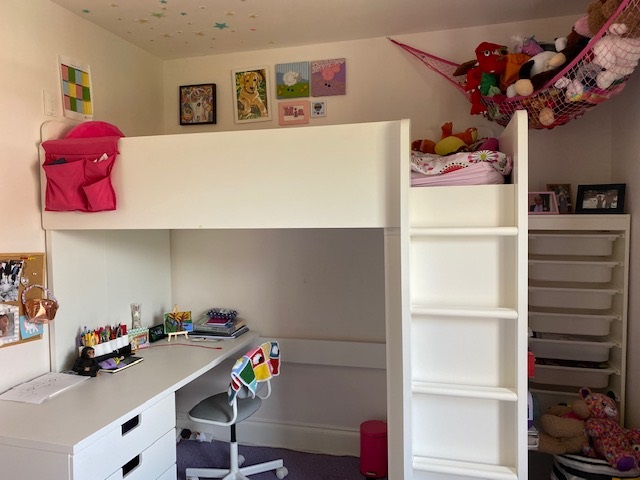
So here is a picture of the Ikea Stuva loft bed as it looks now in my daughter's bedroom!

Ikea Stuva loft bed updated review

The Stuva loft bed has stood up to the last two years really well. It remains in excellent and sturdy condition, and we've had no problems with the bed at all. It just has a few light scratches on it, but that's pretty normal for furniture in a child's bedroom.

The bed unit once assembled is very heavy and there is no way that it could be easily moved. It also won't fit out of a bedroom door, so will need to be built in the room where it will live. So although the loft bed is designed for a small space, there does need to be enough room to assemble it. You can get some sense of how much space will be needed from my time lapse assembly video below:


Because of the size of the bed, it would be next to impossible to move it anywhere once assembled. So there is very little chance of cleaning or replacing the carpet underneath! Before assembling the bed, it's worth having a good look at the different range of assembly options available. Spend some time thinking about the configuration that would fit your space and needs best, as it is a lot easier to assemble it as you want it from the beginning!

The wardrobe under the bed is quite small, and definitely designed for child sized clothes. We have a much larger Ikea wardrobe elsewhere in the room for her clothes, and this wardrobe is used only for dress up clothes and shoes.

The drawers in the desk are a very good size. We use them for some clothing as well as stationery items. We have some Ikea drawer dividers which are really useful but I can't find the ones that we bought, so if you want to buy some I'd recommend checking with Ikea to make sure that you get the same ones that fit.

Mia has plenty of headroom up in the bed. We have high ceilings (250cm) and there is room for me as a small adult to sit upright in the bed. I think that the height of your ceiling would make a big difference to whether this bed would be suitable for older children or adults.

Changing the sheets is pretty easy. I can throw down the pillow and duvet to change them separately, but you do need to be able to get up into the bed to remove and replace the fitted sheet. It gets quite dusty up in the bed so I go up from time to time with the handheld hoover to go around the edges. There is plenty of space around the edge of the mattress to store teddies and books, and unless you are very fussy there is no need to actually make the bed daily as you can't see it from the floor!

The additional Ikea products that we bought to go along with the Stuva loft bed are:

The ÖRFJÄLL children's desk chair in white and Vissle pink. This is a smaller sized desk chair which fits really nicely under the desk and would also suit a small adult, leaving plenty of headroom under the bed while sitting at the desk.

The MORGEDAL medium firm memory foam mattress. I've slept on this mattress a few times and found it very comfortable. You need to be careful with the mattress that you choose for this loft bed as it must be the correct height for safety.

The STICKAT bed pocket which is very handy for keeping the things you need at night close by. You can also see some alternative caddies below, and I'd definitely recommend something like this or else a small shelf above the bed.

Friday, 6 September 2019

Ad - Book review - The Organised Mum Method by Gemma Bray

I received a copy of this book in exchange for a review. This post contains Amazon Affiliate links.

Today I'm sharing a review of a new book - The Organised Mum Method: Transform your home in 30 minutes a day by Gemma Bray. Gemma Bray believes that there is more to life than housework, and she has been sharing her perfected system - The Organised Mum Method - on her blog and social media channels since January 2017. There has been a phenomenal response to her method, and this book contains the tips, tricks, cleaning schedules and more which will help you to get your housework under control and completed quickly and efficiently, leaving you plenty of time to do the things that you'd much rather be doing.

The Organised Mum Method book review

Despite being familiar with the method and already a subscriber to the blog, I must admit that I hadn't actually embarked on the plan myself. With my review copy arriving at the beginning of our school summer holidays, I decided that now was the time to make a proper start, and I've been following the routine for over 8 weeks - enough time to work through the plan in its entirety.

What is the Organised Mum Method?

In a nutshell, the Organised Mum Method involves completing Level 1 daily jobs (which should take 15 minutes), Level 2 jobs in one room each week (which will take 30 minutes), and a Friday Focus where you concentrate thoroughly on one room or area (again for 30 minutes). The Friday Focus rooms rotate through an eight week schedule so that each room receives a deep clean during that time. You are encouraged to use a timer to keep yourself within the time limits and to prevent distraction, although you can spread the cleaning throughout your day in smaller chunks, depending on your personal schedule.

So why buy the book if all the information is available on the website?

Well, I think I can answer that from personal experience. As I said, I was familiar with the method and subscribed to the blog, but I hadn't actually done anything about it. I just needed something to get me started, and for me this book was the kick.

For a start, I found it really helpful to have all the information organised in one place in a sensible order, rather than having to jump around different parts of the website. It's really easy to find what you are looking for when you need to refer back to something.

The book also has plenty of supplementary discussion about the method. For example, I found that the explanation of the rationale behind the method, and why certain rooms are scheduled for particular days, really made sense and helped the plan to stick in my mind.

For me, I find information in book form rather than online much easier to digest. I took the book on holiday with us at the beginning of the summer and made notes about how I was going to use the schedules, ready to go when I got home. Reading the book in advance meant that I was fully familiar with the process before I got started, and I found the tips and advice really motivating.

If I hadn't read the book, I doubt I ever would have started.

The Organised Mum Method review

What was particularly helpful about the book?

Reading the book helped me to understand what stage I was already at when it came to housework. Luckily I do keep my home fairly decluttered so I was able to jump straight in with the method. If your house is quite messy then you are encouraged to complete a one week 'Boot Camp' first to get your house into a state that you can work with.

It also helped to cement the reminder that it's much easier to clean quickly if you don't have to tidy up first. For example, wiping down the kitchen counters only takes a few seconds if they are already clear, so it's an incentive to keep things tidy as you go along so that you can clean more efficiently and stick to the time limits.

How I adapt the method to work in my larger house

One of the things that had first put me off this cleaning method was that I have quite a large house. As all the rooms need to be divided over just four days, I didn't think that I would have time to fit everything in, and it all felt too overwhelming. However I sat down with a pen and paper and came up with a timetable that I felt I could make work for me. Gemma's suggested daily rooms are in italics, and I've added in my extras.

Monday - Living room and dining room
Tuesday - Bedrooms - Master bedroom, Harry's bedroom and en-suite, Mia's bedroom (clean sheets are alternated weekly between ours and the children)
Wednesday - Hallway, cloakroom, study
Thursday - Kitchen
Friday - Focus Day - a rotation of eight different rooms
Weekend - Family bathroom and master bedroom en-suite.

You'll notice that the bathroom/toilet is missing from Gemma's plan. This is because the bathroom comes under the Level 1 jobs and should be cleaned daily. However as our house contains four bathrooms/toilets there is no way that I can clean them all thoroughly, along with the other daily jobs, in just 15 minutes.

So I add the downstairs toilet to Wednesday as our hallway doesn't take long to clean, and I do Harry's en-suite bathroom on Tuesday as it doesn't get much use. Then at the weekend I give the family bathroom and our en-suite a thorough clean. I do clean the toilets more frequently and I wipe down the surfaces in all bathrooms daily.

I have a couple of extra rooms - a dining room and study - which are added on to Monday and Wednesday respectively. I also have two guest bedrooms at the top of the house. These rooms aren't used regularly so I clean them properly as part of the Friday Focus Miscellaneous Rooms (or if we have guests using them!).

Hand holding a cleaning spray
Photo credit JESHOOTS.COM via Unsplash

How realistic is the 30 minutes of cleaning a day?

I do have to accept that along with appreciating the benefits of a larger house I need to spend a little more time cleaning it. So I must admit that it does take me longer than 30 minutes to do my Level 2 jobs. However it's not usually longer than 45 minutes, and if I was stretched for time I could finish within the half hour. I also don't include tidying in my room cleaning, I try to make an effort to keep things tidy daily anyway throughout the house, rather than leaving it until I'm concentrating on a particular room.

Because of my extra bathrooms I do need to spend a short amount of additional time cleaning at the weekend. I could probably fit this cleaning in during the week, but it wouldn't be at the standard I want it to be.

The thirty minutes of daily room cleaning doesn't include the Level 1 jobs, and it also doesn't include things like washing up and wiping surfaces after making a meal, as these are all things which are part of running a home.

Do you still need the book if you follow the method already?

Many people have been following this method for a while now, having used the information on the blog and in the Facebook group, and may feel that they don't need the information in the book. However while I feel that the book is aimed more at people that are new to the system, I think that it would still be of interest to people who are familiar with the method. It helps with understanding more about the method and why it works, and there are lots of really useful tips and pieces of advice.

Has this method worked for me?

My answer to this question has to be yes! There is no doubt that since I started following this method my house has become cleaner. It's a little and often method of cleaning which really does work, and there are so many benefits. For example, when you are dusting the same ornaments every week you start to think about whether you really need them, or whether you could do a little decluttering. When you actually set a timer, you discover just how much you can actually get done in a short period of time if you concentrate and don't allow yourself to be distracted.

I've started to take more notice of my home, and do something about the parts that were bothering me. When you spend the time to care for your house you start to think of ways that you can improve your storage or just make things look a little nicer.

I really felt the benefit a couple of weeks ago before we went away. Normally the week before we go on holiday I'm running around like mad trying to clean everything because I like to come home to a clean house. This time I found myself at a loose end, because everything was already clean!

Obviously there is no escaping the fact that in order to be successful with this method you do actually have to get on and clean, no-one else is going to do it for you. But if you are someone that likes seeing tasks broken down into easily manageable chunks and enjoys the satisfaction of ticking things off a list, then this could well be the system for you.

You can buy the book here -   The Organised Mum Method: Transform your home in 30 minutes a day